


TIMEMORE Chestnut C3 ESP Pro is worth considering if you want a compact manual grinder with espresso-oriented adjustment and a folding handle at $79.08, but it isn’t the strongest choice for frequent espresso grinding because the cited review reports more than a minute for an espresso dose. Its capacity, exact weight, and complete accessory list remain partly unclear.
- The C3 ESP Pro is identified with Timemore S2C600 burrs.
- The Amazon listing describes approximately grind levels and a 0.0233 mm adjustment pitch.
- The related Chestnut C3 ESP has a maximum capacity of grams.
- The listed price is $79.08 against a $99.00 list price.
- The Amazon listing records the grinder as In Stock.
What are the main specifications of the TIMEMORE Chestnut C3 ESP Pro?
The TIMEMORE Chestnut C3 ESP Pro is identified by one review as using Timemore S2C600 burrs. The Amazon listing instead describes patented S2C660 stainless steel conical burrs, so the available sources don’t present a single consistent burr designation. That distinction matters if you’re comparing model specifications rather than relying on the product title alone.
The TIMEMORE Chestnut C3 ESP Pro listing gives approximately grind levels and an adjustment pitch of 0.0233 mm per click. The related Chestnut C3 ESP is reported with a maximum capacity of grams. That capacity should not be presented as a confirmed C3 ESP Pro specification. The available 473.0 g weight belongs to the related Chestnut C3 Pro, not specifically this model. The related C3 ESP is described as using aluminum alloy and stainless steel, but a complete C3 ESP Pro material specification isn’t available. The TIMEMORE Chestnut C3 ESP Pro therefore has useful adjustment information, but incomplete model-specific capacity, weight, and construction data.
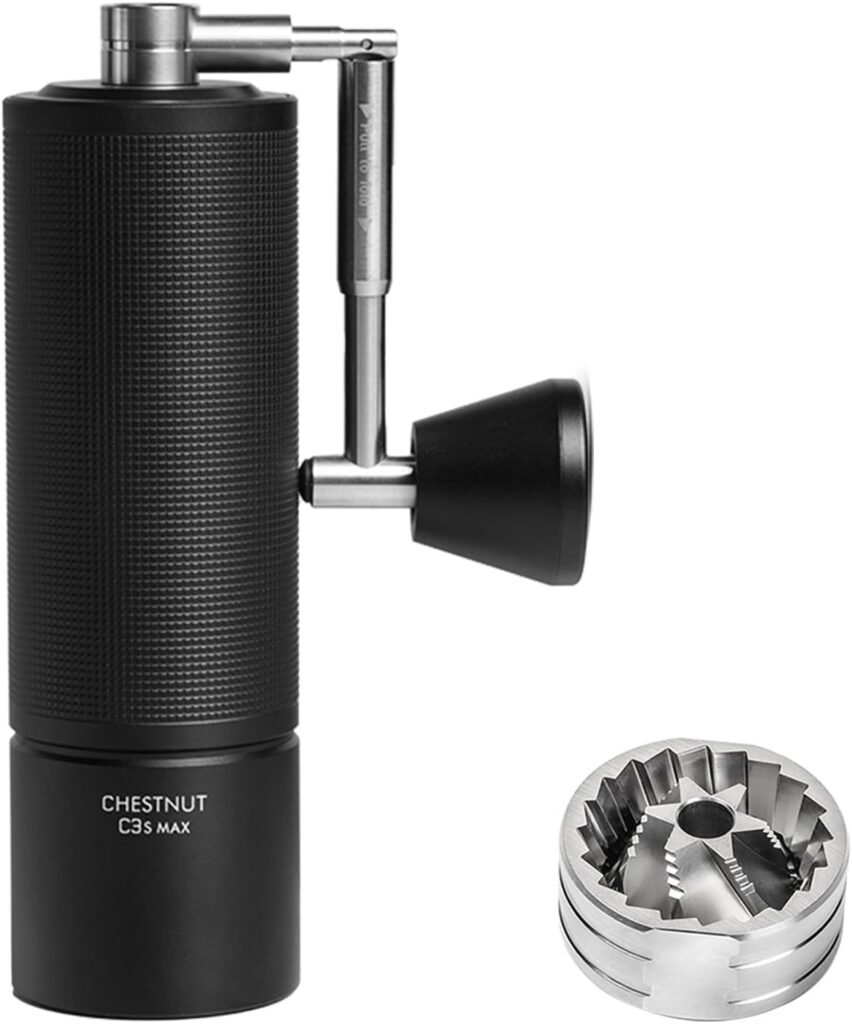

TIMEMORE Chestnut C3 ESP Pro Manual Coffee Grinder, Stainless Steel S2C Conical Burr Hand Coffee Grinder with Foldable Handle, Adjustable Grind Setting for Espresso and Pour Over – Black
$99.00 $79.08
In Stock
As an Amazon Associate, I earn from qualifying purchases
How does the TIMEMORE Chestnut C3 ESP Pro compare with the C3 ESP?
The TIMEMORE Chestnut C3 ESP Pro differs from the C3 ESP mainly in its folding crank: the review says the Pro folds, while the C3 ESP does not. When folded, the TIMEMORE Chestnut C3 ESP Pro handle lies flush against the grinder body, which is useful for storage and travel. A buyer also reported that the fold-down handle suited their tabletop better than a handle that couldn’t fold down.
Price separates the models as well. The C3 ESP is reported to sell at a lower price, while the available Amazon price for the TIMEMORE Chestnut C3 ESP Pro is $79.08, compared with a $99.00 list price. The evidence supports a portability advantage for the Pro, but it doesn’t provide a full side-by-side specification sheet. You should therefore treat the folding handle and price difference as the clearest documented distinctions, rather than assuming every other component changed.
How much does the C3 ESP Pro cost, and what accessories are included?
The TIMEMORE Chestnut C3 ESP Pro is listed at $79.08, with a $99.00 list price. The Amazon listing records the TIMEMORE Chestnut C3 ESP Pro as In Stock. Those are the available price and availability details; no rating is provided in the claim ledger.
The product information confirms a folding handle and the adjustment features described elsewhere, but the available sources don’t provide a complete accessory list for the TIMEMORE Chestnut C3 ESP Pro. A travel bag is documented for the related Chestnut C3 Pro, not for the C3 ESP Pro. You shouldn’t treat that bag as a confirmed inclusion here. The distinction is important because an accessory shown for a related grinder doesn’t establish what arrives with this model. No source in the supplied evidence confirms a dosing cup, brush, carrying case, or other specific accessory for the C3 ESP Pro, so those details are unknown.

How do you adjust the C3 ESP Pro for espresso, pour-over, and other brewing methods?
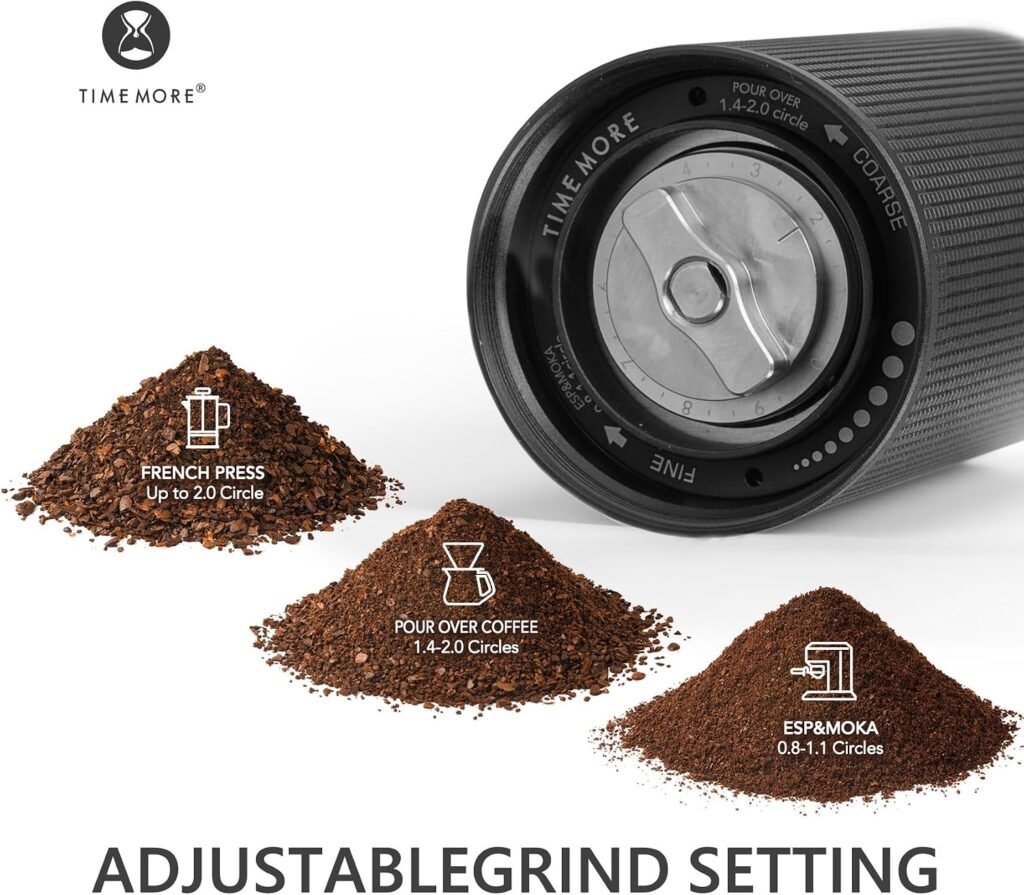
The TIMEMORE Chestnut C3 ESP Pro listing suggests 0.8–1.1 circles for espresso, 1.4–2.0 circles for pour-over, and 2.0–2.3 circles for French press. Clockwise rotation produces a finer grind, while anticlockwise rotation produces a coarser grind. That gives you a starting map from fine to coarse rather than a guarantee that every coffee will brew correctly at those positions.
The TIMEMORE Chestnut C3 ESP Pro is described by the source as suitable for espresso, manual brews, and French press. The TIMEMORE Chestnut C3 ESP Pro listing also presents its pitch as suitable for fine-to-coarse adjustment. However, these ranges are manufacturer or listing guidance, not independently verified brewing results in the supplied evidence. Your coffee, dose, equipment, and target recipe may require a different setting. The sources don’t provide controlled test results for extraction, flavor, flow rate, or repeatability, so the ranges should be treated as starting points.
How many clicks per rotation does the C3 ESP Pro have, and how should you dial in espresso?
The TIMEMORE Chestnut C3 ESP Pro adjustment dial has clicks per turn, according to the cited review. The same review reports 23.3 µm of adjustment spacing per click. The listing expresses the pitch as 0.0233 mm per click, which is the same stated spacing in a different unit.
To read a setting such as 1.6 on the TIMEMORE Chestnut C3 ESP Pro, make one complete turn and stop at graduation mark 6. The cited espresso example, 0.50, means graduation from zero without completing a full turn. A buyer reported that the TIMEMORE Chestnut C3 ESP Pro could miss the exact espresso setting and that dose changes often compensated. That report is buyer opinion, not a controlled measurement. In practice, you can use the click notation to record adjustments precisely, then change grind or dose according to your extraction result.
Is the TIMEMORE Chestnut C3 ESP Pro good for espresso compared with electric and higher-end manual grinders?
The TIMEMORE Chestnut C3 ESP Pro can produce quality espresso according to the cited review, but that reviewer wouldn’t choose it first for espresso. The main documented trade-off is speed: the review identifies the mm burr size as a factor that lengthens espresso grinding time. It reports more than one minute for an espresso dose with the TIMEMORE Chestnut C3 ESP Pro, compared with about seconds using or mm burrs.
Those figures suggest that frequent espresso users may prefer an electric grinder or a higher-end manual grinder with a different workflow, but the supplied evidence doesn’t directly test or specify those alternatives. The TIMEMORE Chestnut C3 ESP Pro also has one buyer-reported concern: the magnetic top had come off more than once, although rarely. That is an isolated buyer report rather than a measured failure rate. The TIMEMORE Chestnut C3 ESP Pro therefore suits buyers who accept manual grinding time, while speed-focused espresso users should weigh the cited trade-off carefully.

How do you clean and maintain the C3 ESP Pro, and can the burrs be removed?
The TIMEMORE Chestnut C3 ESP Pro can be disassembled for burr cleaning according to the reported sequence: unscrew the adjustment dial fully to release the burr, then remove the central rod. That supports burr removal for cleaning, but the available sources don’t describe installing replacement burrs or specify a service interval.
For routine care, the product page advises cleaning the TIMEMORE Chestnut C3 ESP Pro with a brush or air hand pump rather than washing or rinsing it. The same source recommends storing the TIMEMORE Chestnut C3 ESP Pro in a cool, dry place. These instructions give you a basic maintenance method without claiming that the grinder is waterproof or washable. The supplied evidence doesn’t establish how often you should strip the burr assembly, whether replacement parts are available, or how long the burrs should last. Keep those points open when comparing ownership requirements with another manual grinder.
How does the TIMEMORE Chestnut C3 ESP Pro compare with similarly priced manual grinders?
The TIMEMORE Chestnut C3 ESP Pro has a 30-click adjustment dial and is identified with S2C600 burrs in one review. Its handle attachment uses a ball bearing, while the cited comparison says competing brands use a clip system. The related Chestnut C3 Pro is listed with mm stainless steel conical burrs and an approximately 25-gram catch-cup capacity, but those figures aren’t confirmed specifications for the C3 ESP Pro.
The broader Chestnut ESP description says its burr is derived from the S2C860 burr used in the Chestnut X and features the patented S2C Spike to Cut philosophy. Those details describe the Chestnut ESP evidence, not a complete C3 ESP Pro specification. The available sources don’t provide complete specifications or prices for three or more competing manual grinders, so a broad value ranking would go beyond the evidence. The useful comparison here is limited to the named TIMEMORE models and the documented handle, burr, and adjustment details.
Pros and Cons
Pros
- The folding crank lies flush against the grinder body for storage and travel.
- The adjustment system provides clicks per turn and reported 23.3 µm spacing per click.
- The product listing provides separate starting ranges for espresso, pour-over, and French press.
- The grinder can be disassembled for burr cleaning by fully unscrewing the adjustment dial and removing the central rod.
- The listed price is $79.08 against a $99.00 list price.
Cons
- The available sources don’t confirm the C3 ESP Pro’s exact capacity or weight; the 20-gram and 473.0 g figures belong to related models.
- The cited review reports more than one minute to grind espresso, compared with about seconds using or mm burrs.
- A buyer reported that the grinder could miss the exact espresso setting and that dose adjustments were often needed to compensate.
- A buyer reported that the magnetic top had come off more than once, although rarely.
- The available sources don’t provide a complete C3 ESP Pro accessory list.
Final Verdict
| Model | Burr specification |
|---|---|
| C3 ESP Pro | Timemore S2C600 burrs; patented S2C660 stainless steel burrs |
| Chestnut ESP | Burr derived from the S2C860 burr featured in the Chestnut X; features the… |
| Chestnut C3 Pro | 38 mm stainless steel conical burrs |
| Model | Burr information | Adjustment information | Capacity information | Handle or portability detail |
|---|---|---|---|---|
| C3 ESP Pro | Timemore S2C600 burrs; listing also says S2C660 stainless steel conical burrs | 30 clicks per turn | Not confirmed for this model | Folding crank; handle lies flush when folded |
| Chestnut ESP | Burr derived from S2C860; S2C Spike to Cut philosophy | Up to clicks per circle | Not provided | No comparable handle detail provided |
| Chestnut C3 Pro | 38 mm stainless steel conical burrs | Not provided | Around grams | Travel bag reported with the related model |
Key Takeaways
- Treat the 20-gram capacity and 473.0 g weight as related-model figures, not confirmed C3 ESP Pro specifications.
- Use the listing’s espresso, pour-over, and French press ranges as starting points rather than independently verified results.
- Expect slower espresso preparation than the cited comparison with or mm burrs.
- The folding handle is the clearest documented advantage over the C3 ESP for storage and travel.
- Clean with a brush or air hand pump, not by washing or rinsing the grinder.
Frequently Asked Questions
What are the key differences between the Timemore C3 ESP and C3 ESP Pro grinders?
The C3 ESP Pro has a folding crank, while the C3 ESP lacks one and sells at a lower price. The Pro handle lies flush against the grinder body when folded, and its available price is $79.08 against a $99.00 list price.
Are Timemore grinders worth it?
The evidence supports considering the C3 ESP Pro if you value a folding handle and fine adjustment, but espresso grinding is reported to take more than one minute. The sources don’t provide enough complete comparative pricing or specifications to make a general claim about all Timemore grinders.
Why is Costco getting rid of coffee grinders?
The supplied sources don’t provide information about Costco removing coffee grinders, so the reason is unknown.
What is the best manual coffee grinder on the market?
The supplied evidence doesn’t identify a single best manual coffee grinder. It provides limited comparisons involving the C3 ESP Pro, Chestnut ESP, and related Chestnut C3 Pro, without complete specifications or prices for a wider group.
Disclosure: As an Amazon Associate, I earn from qualifying purchases.